
Growing Beef Newsletter
December 2025, Volume 16, Issue 6
Swath Grazing Third Semester
Garland Dahlke, IBC research scientist
Swath grazing is a winter forage management strategy used by Iowa State University and many others across the snow-covered regions of the U.S. and Canada. The grazing, labor and cost efficiencies are significant, however, forage quality does suffer as winter changes into spring, and during winters of many freeze-thaw events this quality suffers even greater declines. This decline, although significant, really seems to be of consequences as the pregnant cow moves into her final month of gestation. Allowing more forage availability, at the cost of more waste, is one way to allow the cow to choose the better quality feed and maybe maintain herself in this final month prior to calving, but often where supplementation is possible a bit of energy and protein supplementation placed on top of the existing swaths will suffice.
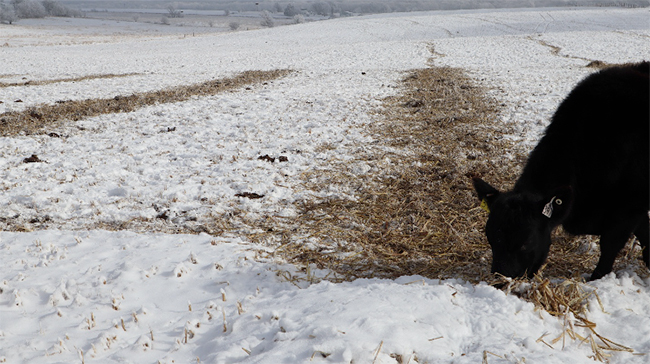
The following is an example of what one might see in terms of the quality drop from a second cutting of forage sorghum collected a few years ago at ISU. As the forage weathers, as also occurs in the summer with dry hay for baling, the nonfiber carbohydrate is what is lost first followed by the more digestible fiber. This is where the energy lies in the forage and the components we really do not want to lose.
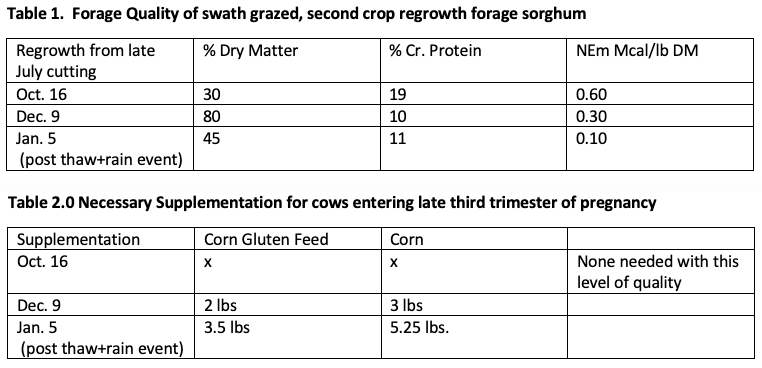
During years where the material is cut, raked, and followed by dry, cold weather to preserve it we would not see much degradation. In the Table 1 situation, fluctuating weather patterns had a pretty large impact and although the quality is still better than what corn stalks would be at this same time under similar circumstances a feeding intervention needs to occur for these cows if calving is to occur in February. Likewise, the forage sample represented assumed cows ate all the provided forage. In reality we probably would see about 70% forage utilization (30% wasted). With this in mind and testing the material that remains behind the quality of the feed consumed is considerably better. NEm for instance calculates to be about 40% better than the complete sample represented in Table 1 based on the mathematical difference from feed tests from the refusals. Every year is a little different in regards to the weather and different forages also respond differently to weathering, for instance pearl millet seems to tolerate the weather better. Therefore, it is a matter of responding to the existing conditions appropriately to ensure a good outcome.
This monthly newsletter is free and provides timely information on topics that matter most to Iowa beef producers. You’re welcome to use information and articles from the newsletter - simply credit Iowa Beef Center.



