
Growing Beef Newsletter
December 2025, Volume 16, Issue 6
The vitamin A trust fund: Why you should invest in generational wealth in your herd
Marissa Eekhoff, graduate student, and Dr. Stephanie Hansen, professor, Iowa State University
As a required micronutrient, vitamin A is well worth its pretty penny. Newborn calves are born with very little vitamin A due to a lack of placental transfer (Baker et al., 1953). Without vitamin A, calves are extremely susceptible to immune challenges like scours/diarrhea or respiratory disease (Stewart and McCallum, 1938; Kume and Toharmat, 2001). Additionally, calves can display other vitamin A deficiency symptoms like poor vision or reduced growth.
Calves receive the vitamin A they need from colostrum - think about it as their inheritance. Colostrum is fortified with vitamin A from a combination of the dam’s vitamin A stores in her liver (40%) and her current vitamin A intake (60%; Branstetter et al., 1973; Tomlinson et al., 1974). Using the generational wealth analogy, let’s call the dam’s liver vitamin A her savings account, and her current vitamin A intake her income. To build a strong inheritance for her calf and ensure there is adequate vitamin A in the colostrum, the cow needs both good vitamin A status, and vitamin A intake. But how does she accrue those savings and earn that daily vitamin A income?
Vitamin A stores (savings) are built up over the summer months due to the consumption of fresh pasture, which is rich in beta carotene. Beta carotene is a precursor to vitamin A and is able to be converted to vitamin A in the cow’s intestine (Goodman et al., 1967). Green pasture is the most rich in beta carotene, followed by green alfalfa hay, then grass hay, and lastly, corn silage and other corn products (cracked corn, distillers grains; Maynard, 1979). Beta carotene is quickly degraded due to oxidation and light, resulting in a lower concentration in stored forages and feedstuffs. The current NASEM (2016) guidelines for vitamin A likely assume cows have consumed good green grass for several months before the winter feeding period. However, as of November 18, 2025, 33% of the cow inventory in the U.S. was in a drought area (USDA). While Iowa thankfully is not under widespread drought currently, we have had many recent years of drought where cows may not be accruing those summer savings as expected.
As cows move into late gestation, which aligns with the winter months for those with spring calving herds, vitamin A intake (income) is more crucial than ever. Winter feeding often means a heavy reliance on stored forages, which may have low vitamin A concentrations. During this time the calf is experiencing significant in utero growth and colostrum formation is beginning. Gestating beef cows are recommended to have at minimum approximately 33,000 IU supplemental vitamin A/day (1,300 IU/lb dry matter). Recent research shows that this recommendation is likely too low to result in an increase in the vitamin A status of young calves (Speer et al., 2024). This same research suggests producers should aim to have vitamin A intakes of approximately 90,000 IU/day (3,900 IU/lb dry matter) to increase the inheritance to the calf.
As we enter the winter months, there are key considerations producers should have in mind to ensure their cows have adequate vitamin A to pass on to their calves.
- What is your hay quality like? Nice green grass hay or pretty brown, old hay?
- Has your hay been tested? (Remember you can work with your local field specialist to borrow a hay probe and learn how to sample!)
- What is your free choice mineral consumption like throughout the year? If cows are going through mineral quicker than they should, you may have a problem that can be exacerbated when cows are moved into closer quarters (dry lot, confinement).
- What is the vitamin A concentration in your mineral?
- When are your cows due to calve? Vitamin A supplementation needs to be at least adequate during late gestation to provide the generational wealth!
If you have concerns about your hay quality or vitamin A supplementation, please reach out to your local extension specialist. Don’t leave those newborn calves susceptible to disease due to a lack of vitamin A. This mighty micronutrient is worth every penny to deliver the best inheritance to the calf and give you a strong, healthy, vigorous calf!
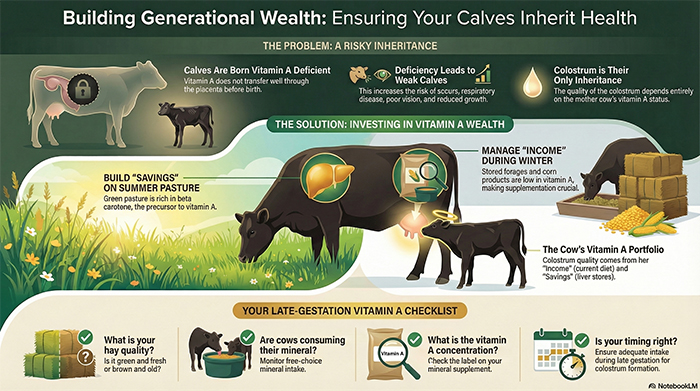
Diagram of vitamin A pathway: from cow to calf.
Literature Cited
Baker, F. H., R. Macvicar, L. S. Pope, and C. K. Whitehair. 1953. Placental and Mammary.Transfer of Vitamin A and Carotene by Beef Cows. Proceedings of the Society for Experimental Biology and Medicine. 83. doi:10.3181/00379727-83-20421.
Branstetter, R. F., R. E. Tucker, G. E. Mitchell, J. A. Boling, and N. W. Bradley. 1973. Vitamin A transfer from cows to calves. Int J Vitam Nutr Res. 43:142–6. Available from: http://www.ncbi.nlm.nih.gov/pubmed/4736775
Goodman, D. S., H. S. Huang, M. Kanai, and T. Shiratori. 1967. The Enzymatic Conversion of All-trans β-Carotene into Retinal. Journal of Biological Chemistry. 242:3543–3554. doi:10.1016/S0021-9258(18)95896-5. Available from: https://linkinghub.elsevier.com/retrieve/pii/S0021925818958965
Kume, S., and T. Toharmat. 2001. Effect of colostral β-carotene and vitamin A on vitamin and health status of newborn calves. Livest Prod Sci. 68:61–65. doi:10.1016/S0301-6226(00)00214-1. Available from: https://linkinghub.elsevier.com/retrieve/pii/S0301622600002141
Maynard, L. A. 1979. Animal nutrition. 7th ed. (J. R. Campbell and C. Hall, editors.). McGraw-Hill, New York.
National Academics of Sciences, E. and M. 2016. Nutrient Requirements of Beef Cattle, Eighth Revised Edition. The National Academies, Washington, DC. USDA. https://agindrought.unl.edu/Maps.aspx?2
Speer, H. F., K. H. Wilke, and M. E. Drewnoski. 2024. Effects of vitamin A supplementation on liver retinol concentrations of beef cows and their calves managed in confinement. Applied Animal Science. 40:619–626. doi:10.15232/aas.2024-02564.
Stewart, J., and J. W. McCallum. 1938. “White Scour” in calves and related infections. Journal of Comparative Pathology and Therapeutics. 51:290–295. doi:10.1016/s0368-1742(38)80028-x.
Tomlinson, J. E., G. E. Mitchell, N. W. Bradley, R. E. Tucker, J. A. Boling, and G. T. Schelling. 1974. Transfer of Vitamin A from Bovine Liver to Milk. J Anim Sci. 39:813–817. doi:10.2527/jas1974.394813x.
This monthly newsletter is free and provides timely information on topics that matter most to Iowa beef producers. You’re welcome to use information and articles from the newsletter - simply credit Iowa Beef Center.



