
Growing Beef Newsletter
July 2026, Volume 17, Issue 1
The heat is on: heat stress in beef cattle
Emily Partee, graduate assistant, and Dr. Stephanie Hansen, professor, Iowa State University
Every summer there is one phrase that crosses all of our minds: "It’s not that hot, but it’s the humidity that’ll get ya!" When late summer in the Midwest arrives, if you are feeling the effects of corn sweat, you can be sure that your cattle are too. Heat stress negatively impacts livestock around the globe, and Iowa is no exception. Understanding how heat stress is affecting your cattle is the first step to help your cattle get through these hot summer months.
Heat stress occurs when the heat generated by the animal is greater than its ability to release that heat into the environment. To offload excess heat, cattle rely primarily on evaporative cooling mechanisms such as sweating and panting (Idris et al., 2021). When high temperatures are combined with elevated humidity, these cooling mechanisms become less effective because moisture cannot readily evaporate from the animal. When cattle cannot offload their body heat, heat stress begins. To reduce the heat produced from ruminal fermentation, cattle will decrease feed intake. However, this decrease in feed intake is one of the main drivers of decreased performance during the summer months (O’Brien et al., 2010).
The Temperature Humidity Index (THI) is one of the most common tools used to estimate the risk of heat stress in cattle. The Livestock Safety Weather Index classifies THI categories as Normal (≤ 74), Alert (75–79), Danger (80–83), and Emergency (≥ 84) (LWSI; Livestock Conservation Incorporated, 1970). These values are calculated using both ambient temperatures and relative humidity. Meaning, as both of those go up, so does the THI. As shown in Figure 1, feed intake by yearlings at Iowa State University last summer decreased when the index crossed into danger and emergency categories. While these values provide a general idea of when cattle may be experiencing heat stress, they do not take into consideration two very influential environmental factors: solar radiation and wind speed (Gaughan et al., 2008). Direct sunlight can increase the heat load experienced by cattle, while increased wind speed can help cattle dissipate heat more effectively. The most common and easily implemented strategies to prevent heat stress include providing fresh water near your animals, as well as adequate shade structures. Simply providing shade has been shown to reduce panting in cattle (Brown-Brandl et al., 2005). Providing ample airflow using fans in enclosed housing is also beneficial, as it helps cattle dissipate excess heat into the environment.
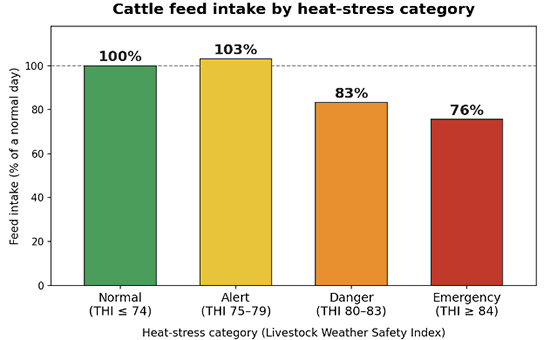
Figure 1. Relationship between THI category and feed intake. As THI values increase into the Danger and Emergency categories, cattle consume less feed compared to their normal conditions.
Cattle can experience high THI values without necessarily becoming heat stressed. A single day of elevated THI followed by cooler nighttime conditions should allow for cattle to dissipate accumulated heat and recover (Mader et al., 2006). However, when elevated THI values persist for multiple days and nights during a “heat wave”, cattle will be unable to adequately offload heat. During these periods, cattle will exhibit visual signs of heat stress including increased panting and sharp declines in intakes. It is during these prolonged heat events that cattle are at the greatest risk of severe heat stress and even death and additional management interventions may be needed.
As temperatures rise, cattle increase their respiration rate to offload excess body heat. A recent summer study at Iowa State University collected respiration rates from 48 black-hided Angus yearling steers housed in partially shaded pens. Respiration rates were taken during a heat event (HE) in June (Early HE) and again in August (Late HE), on the first and last day of the HE. In both events, respiration rates increased from the beginning to the end of the event, as cattle accumulated heat load. Although the THI values for the two HE were similar, the late HE was longer in duration and had lower wind speeds, perhaps explaining why respiration rates increased more during the event. These yearlings also carried more condition in August than in June. Ultimately, weather conditions and the animal itself can influence the heat stress response in beef cattle.
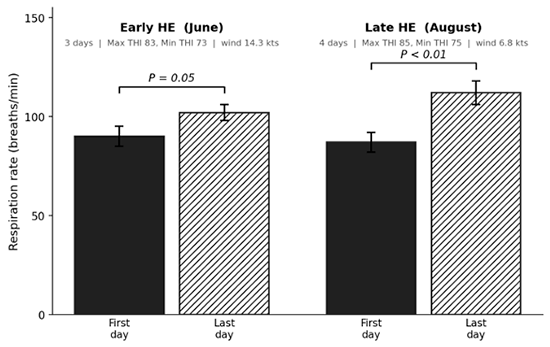
Figure 2. Respiration rates of cattle during two heat events with different weather conditions. Cattle exhibited an increase in respiration rate during both heat events but saw a greater increase during the Late HE.
During the summer months, check your cattle more frequently and pay attention to when panting begins to increase. Recognizing these early signs of heat stress can help you determine when additional management interventions may be needed. Track panting along with the temperature and humidity, and you will begin to recognize when your cattle start reacting to the heat. Open-mouth panting is a clear sign of heat stress (Gaughan and Mader, 2014). At that point, cattle are struggling to dissipate excess heat, and intervention may be necessary. Once you know when your cattle begin to experience heat stress, you can start anticipating future heat waves and implement heat management strategies before cattle begin showing signs of stress.
Not all cattle respond to heat stress the same way. As we learn more about heat stress, it is becoming clear that the severity of heat stress can vary among individual animals and herds due to differences in genetics and management practices (Shephard and Maloney, 2023). For producers looking to take heat stress monitoring a step further, precision livestock technologies can provide additional insight into how individual cattle respond to heat, helping inform management decisions. Devices such as accelerometer ear tags provide valuable data, including rumination and ear temperature. Rumen boluses can also be used to collect rumen-level data such as pH, temperature, and water intake. Smart feeders use electronic identification (EID) tags to monitor individual feed intake. Although these technologies may seem overwhelming, collecting data on even just a few animals can provide valuable insight into how your herd responds to heat. These data can help guide management decisions and identify when intervention may be needed.
Another crucial heat stress mitigation strategy is targeting your animals' nutritional requirements during the summer months. Heat stress places additional demands on the animal's body, requiring energy to maintain normal physiological function. Vitamins and minerals such as zinc, copper, and manganese help support immune function (Wagner et al., 2023) and provide antioxidant support, along with selenium and vitamin E, to protect the animal from the oxidative stress associated with heat stress (Brenneisen et al., 2005).
For macro minerals, consider electrolytes such as sodium and potassium, which help maintain the animal’s acid–base status (West et al., 1992). During heat stress, increased panting causes cattle to lose carbon dioxide, which can disrupt normal acid–base balance. Excessive panting also increases drooling, resulting in the loss of saliva that normally helps buffer the rumen. Increasing dietary sodium and potassium during periods of heat stress can help replace electrolytes lost through drooling, sweating, panting, and increased urinary output (Pacheco et al., 2018). Alternatively, feed additives such as certain essential oils, including capsaicin, cinnamaldehyde, eugenol, and peppermint, may help cattle cope with heat stress. Capsaicin, in particular, is thought to support the physiological response to heat stress through its role as a vasodilator, which increases blood flow throughout the body and may help cattle dissipate excess heat (Wells, 2024).
There is no one-size-fits-all solution to heat stress in cattle. Every operation is different, but understanding how your cattle respond to hot, humid conditions can help you make proactive management decisions. Providing shade, fresh water, adequate airflow, and proper nutrition can go a long way toward maintaining performance and protecting animal welfare. The humidity may get you, but with the right management, it doesn't have to get your cattle.
References
Brenneisen, P., H. Steinbrenner, and H. Sies. 2005. Selenium, oxidative stress, and health aspects. Mol. Aspects Med. 26:256–267. doi:10.1016/j.mam.2005.07.004.
Brown-Brandl, T. M., R. A. Eigenberg, J. A. Nienaber, and G. L. Hahn. 2005. Dynamic response indicators of heat stress in shaded and non-shaded feedlot cattle, part 1: Analyses of indicators. Biosyst. Eng. 90:451–462. doi:10.1016/j.biosystemseng.2004.12.006.
Gaughan, J. B., and T. L. Mader. 2014. Body temperature and respiratory dynamics in un-shaded beef cattle. Int. J. Biometeorol. 58:1443–1450. doi:10.1007/s00484-013-0746-8.
Gaughan, J. B., T. L. Mader, S. M. Holt, and A. Lisle. 2008. A new heat load index for feedlot cattle. J. Anim. Sci. 86:226–234. doi:10.2527/jas.2007-0305.
Mader, T. L., M. S. Davis, and T. Brown-Brandl. 2006. Environmental factors influencing heat stress in feedlot cattle 1,2. Available from: https://academic.oup.com/jas/article/84/3/712/4778579
O’Brien, M. D., R. P. Rhoads, S. R. Sanders, G. C. Duff, and L. H. Baumgard. 2010. Metabolic adaptations to heat stress in growing cattle. Domest. Anim. Endocrinol. 38:86–94. doi:10.1016/j.domaniend.2009.08.005.
Shephard, R. W., and S. K. Maloney. 2023. A review of thermal stress in cattle. Aust. Vet. J. 101:417–429. doi:10.1111/avj.13275.
Wagner, J. J., L. N. Edwards-Callaway, and T. E. Engle. 2023. Vitamins and Trace Minerals in Ruminants: Confinement Feedlot. Veterinary Clinics of North America - Food Animal Practice. 39:505–516. doi:10.1016/j.cvfa.2023.06.005.
This monthly newsletter is free and provides timely information on topics that matter most to Iowa beef producers. You’re welcome to use information and articles from the newsletter - simply credit Iowa Beef Center.



