
Growing Beef Newsletter
June 2026, Volume 16, Issue 12
Creep feed myths
Erika Woolfolk, ISU Extension beef specialist and Beth Reynolds, IBC Program Specialist
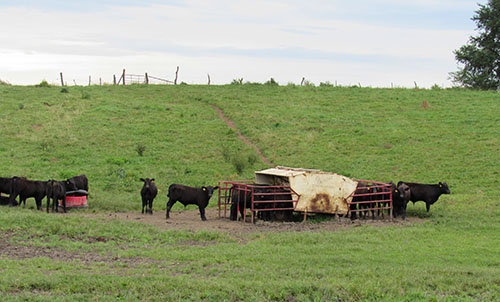 If contemplating creep feeding calves during the summer months, the first step is often putting pen to paper and weighing the costs vs benefits. In a year with extremely strong beef prices and low to moderate feed prices, it should not be surprising that the added pounds gained from creep feeding pencil out. However, before making the decision to creep or not, producers should have realistic expectations of what creep feeding will - or will not - do.
Let’s review some of the most common “myths” we hear as extension specialists.
Myth: “Creep feeding takes pressure off the cow.”
Fact: When given the opportunity, calves prefer milk over any other form of feed (creep feed, forage, etc.), so calves will continue to consume all of the dam’s available milk. Therefore, creep feeding doesn’t result in less demand on the cow. If the goal is really to allow cows to maintain or regain body weight, early weaning is a better option. Ceasing lactation reduces cow requirements by 20% compared to late lactation requirements.
Myth: "Creep feeding saves forage."
Fact: If forage quality and quantity is high, calves likely won’t experience a weight benefit from additional nutrition. During the summer slump or drought conditions, a calf's forage intake may drop slightly, but it is not enough to offset pasture needs or lower the overall grazing pressure on pastures. A more economical option and long-term benefit to both cows and calves is to wean early. Research from SDSU showed that weaning calves 90 days early cut forage disappearance by ~35%.
Myth: "Creep feeding improves long-term heifer performance."
Fact: Excessive creep feeding can result in fatty udders and poor udder development of heifers retained for breeding. Studies demonstrating this have heifer calves gaining over 2 lbs per day for longer than 30 days. Long-term research has shown that heifers with prolonged access to creep-feed produce less milk and wean lighter calves.
Myth: “All creep feed is the same.”
Fact: “Creep feed” is not a specific feed. Rather, it refers to the method of providing feed to calves that the cows do not have access to. Creep feed formulations can be either a high protein or a high energy supplement, and producers need to select a feed based on the limiting nutrient in the base diet (ie: milk + grass). There is a wide range in expected feed conversion of the creep feed based on the nutrient profile of the feed and the base diet, with studies reporting anywhere between 3:1 or 20:1 lbs of feed to gain. In general, high-protein creep feeds (>20% crude protein) often limit creep feed intake and encourage forage intake and improved forage digestion. The lower intake lends to better feed to gain conversion rates but lower weight gains. High-energy creep feeds (commonly between 12 - 16% crude protein) are often fed at free choice which leads to the greater weight gain. The best creep feed response is often achieved when creep feed is fed on a low quality, limited forage. For those grazing Iowa pastures, planning a 6:1 to 8:1 feed conversion is generally a good starting point. Further discussions with the nutritionist can help get a more accurate estimate for specific scenarios.
Myth: "Creep feeding is universally profitable for all herds."
Fact: Profitability depends on the cost of the feed delivered versus the value of the added weight on sale day. For producers that retain ownership through the backgrounding or finishing phase, non-creep-fed calves will experience compensatory gain during the backgrounding phase compared to creep fed counterparts, which is often significant enough to put total selling weight near equal. For those that specialize in high quality beef, creep feeding has shown a positive impact on final marbling scores. Providing creep feed for a short 2-4 week period prior to weaning is another common practice that does not largely influence gain but can be a significant tool to help start freshly weaned calves on feed.
When deciding whether to creep feed, consider more than the feed cost and revenue from each pound gained. Less obvious impacts, costs and benefits are just as important to consider.
This monthly newsletter is free and provides timely information on topics that matter most to Iowa beef producers. You’re welcome to use information and articles from the newsletter - simply credit Iowa Beef Center.



