
Growing Beef Newsletter
June 2026, Volume 16, Issue 12
Trait definitions and statistical methods for genetic evaluation of bovine respiratory disease
Audrey Tarochione, animal breeding and genetics, Iowa State University
Bovine respiratory disease (BRD) costs the U.S. feedlot industry an estimated $1 billion annually in production losses due to decreased performance and carcass value, increased drug costs, and mortality. While BRD is an economically relevant trait, no national cattle evaluation (NCE) exists to aid producers in genetic selection for improved calf health. One reason for this limitation is a lack of research examining the usefulness of various trait definitions and statistical methods for evaluation of BRD. A recent study at Iowa State University compared BRD incidence and severity traits analyzed with linear and threshold models to explore the relative advantages of different approaches to genetic improvement.
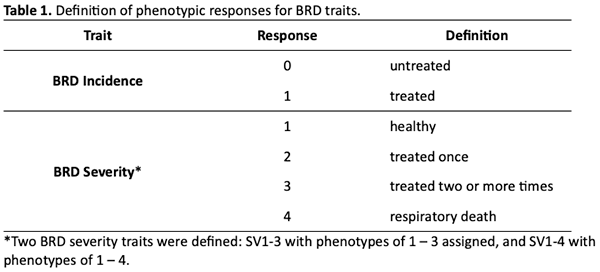
Using historical treatment records on weaned seedstock calves, BRD traits were characterized (Table 1). Disease incidence (BRD0-1) was defined as a binary trait, where a calf either remained untreated (0) or received one or more treatments for BRD (1). Disease severity provided additional granularity and was assessed with two traits. Severity1-3 (SV1-3) described number of treatments, where calves were scored as healthy (1), treated once (2), or treated two or more times (3). Severity1-4 (SV1-4) incorporated death records with a fourth response level to indicate respiratory death (4).
All traits were evaluated using both linear and threshold animal models. Linear models treated the observed response as continuous. Threshold models converted the observed response to the underlying liability scale and were more biologically representative of the data due to the structure of BRD traits. Heritability estimates were low (Table 2), as is expected for health traits. These estimates indicate that, despite being heavily influenced by environment, there is sufficient genetic variation in BRD health to allow for genetic improvement. Given the non-continuous nature of BRD traits, threshold models achieved higher heritability estimates than linear models. Although estimates between the threshold models were similar, results showed that the use of more information for severity traits compared to BRD0-1 increased heritability estimates.
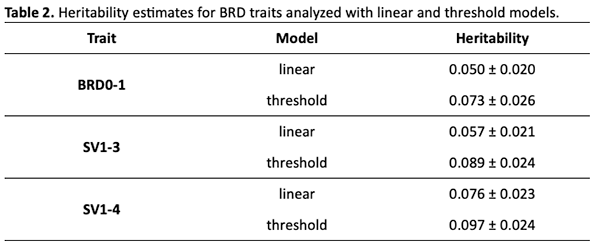
This study showed that trait definition matters more than modelling procedure for genetic evaluation of BRD, and results suggest that a severity trait is the most advantageous. Due to the binary status of BRD0-1, there is no observable difference between a calf that recovers after a single treatment and a calf that requires multiple treatments or dies. The increased granularity of disease severity compared to incidence allows for greater capture of between-animal differences. Data collection should include number of treatments and death to leverage as much useful information as possible. While other challenges in animal traceability and data collection still limit the implementation of a BRD NCE, this study establishes a foundation for trait definition and statistical procedures that can be used to develop an NCE in the future.
This monthly newsletter is free and provides timely information on topics that matter most to Iowa beef producers. You’re welcome to use information and articles from the newsletter - simply credit Iowa Beef Center.



