
Growing Beef Newsletter
October 2026, Volume 17, Issue 4
Carcass ultrasound certification
Patrick Wall, ISU beef specialist
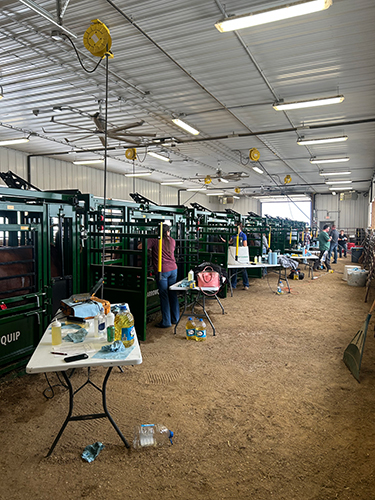 Becoming a Certified Ultrasound Technician for carcass traits has been an annual opportunity in the US since its inception at Iowa State University in the mid-1990s. The Ultrasound Guidelines Council (UGC) was formed in 2002, standardizing the process across all beef cattle breeds. The certification event has moved across the country in the last 20+ years (Georgia, Iowa, Kansas, Texas). The most recent host was South Dakota State University in mid-September.
The host site for this event must adhere to a laundry list of requirements. They must have access to a number of head-catch squeeze chutes. Fortunately, Arrowquip has made a long-term commitment since 2018 to help ensure this event can happen. They’ve sent brand new chutes to the host site every year! Next, a Meat Science group and a commercial packing plant must work together to collect carcass data in addition to removing a portion of the ribeye roll for intramuscular fat (IMF) determination. They must also have access to a source of yearling-age breeding cattle to complete the 40 head requirement. These are often Beef Teaching Farm heifers or bulls used for undergraduate classes or research. The most difficult requirement is access to 30+ market-ready cattle that can either be pulled off a current research trial or used at the end of the trial pre-harvest. As you might imagine, gentle disposition and a willingness to stay on feed and water only heighten the challenge…and the market risk that comes along with it. Finally, a willing staff of graduate students, faculty, and research/teaching farm employees have to put in some pretty long hours to make this event happen.
If a technician scans seedstock cattle at your farm, they must successfully complete the UGC Certification exam. This insures qualified people do the work, and the resulting carcass ultrasound data is as consistent and accurate as it can be. While the ultrasound industry has matured in the United States, widespread adoption of the standards and process is still quite new in other beef producing countries. Recent interest from nations like New Zealand, Australia, Paraguay, and Brazil has increased. Carcass ultrasound is not new in those countries, but the increased accuracy and consistency brought forth by the US system and high standards has piqued their interest. The 2026 Certification hosted 38 participants from 5 countries.
The certification "exam" is quite daunting. Each participant scans 40 head of cattle. At least 30 of those must be harvested shortly after the event. This tests the accuracy of not only the ultrasound machines in use, but also the technicians operating them versus actual carcass data in a commercial packing facility. The remaining 10 head are compared against reference data from experienced technicians. Certified lab technicians interpret the images for both the quality of the image as well as the carcass datapoints (Backfat, Ribeye Area, Marbling). Statistical standards are set by UGC, and a technician must meet or exceed those standards in order to certify. Interested in becoming a UGC Certified Carcass Ultrasound Technician? For more information on future training & certification events, visit www.ultrasoundguidelinescouncil.org.
Strong global beef demand is no accident. It has taken stringent selection and culling at the seedstock level, plus enhanced animal health, nutrition, and management at the feedyard. No doubt, ultrasound technology…and the accuracy of the system in place…has played an important role.
This monthly newsletter is free and provides timely information on topics that matter most to Iowa beef producers. You’re welcome to use information and articles from the newsletter - simply credit Iowa Beef Center.



