
Aimee Wertz-Lutz, IBC director column
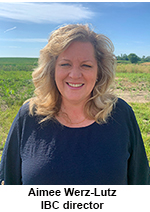 Aimee Wertz-Lutz, IBC director, writes this monthly column featured in Iowa Cattleman Magazine.
May 2026
Value of key technologies used with feeder cattle
Current cattle feeding practices include cattle being fed over 200 days to heavier weights and often higher body fat composition. This warrants viewing commonly used technologies such as Ionophores, Growth-Promoting Implants, and Beta-Agonists through the lenses of current feeding practices.
Ionophores: Ionophores are a long-used technology in feeder cattle. For cattle on high-concentrate diets for >200 days, this technology lessens the likelihood of bloat and acidosis, which can be deadly. Additionally, ionophores aid in the prevention and control of coccidiosis and shift rumen microbial fermentation, resulting in improved feed conversion of 5 to 10% over cattle not fed an ionophore. For feeder cattle, feed cost can account for up to 75% of the cost of gain, so small improvements in feed conversion contribute significantly to improved cost of production.
Growth-promoting implants: In the past several years, there have been changes to the FDA Guidance on the use of growth-promoting implants in cattle. The most significant change is to re-implant guidelines with re-implanting within a phase limited to only implants specifically labeled for re-implant; this significantly reduces the number of re-implant combinations. To recognize the benefits of growth-promoting implants, it is important for the payout period of the selected implant to cover the full feeding period. Traditional growth-promoting implants currently on the market have payout periods of 90-120 d, whereas extended-release implants have payout periods of 200-400 days. Currently, finishing cattle are being fed for more than 200 days. To ensure the feeding period is covered, a growth-promoting implant with a re-implant option or an extended-release implant should be considered. Depending on the selected implant and the remaining length of the feeding period, it may also be necessary to delay implanting to ensure the payout covers the remaining feeding period. Growth-promoting implants have one of the best returns on investment of any technology used with feeder cattle.
Although the response is variable depending on the chosen implant strategy, expected results can be 8% to 28% improved growth rate, a 5% to 20% improvement in feed conversion, and a 3% to 10% increase in lean carcass mass when compared with non-implanted cattle. However, to recognize the full benefit of implanting, it is important that good implant technique is used. Lost, bunched, or crushed pellets or abscesses around the implant site reduce implant response.
Good technique includes:
1) Restraint: keeping cattle heads restrained to allow proper implant placement and lessen the risk of injury to the individual implanting the cattle.
2) Sanitation: It is important to clear the ear of fecal contamination, disinfect the needle before implanting, and replace implant needles as they become dull, burred, or bent.
3) Placement: Insert the needle subcutaneously in the back middle third of the ear, avoiding scar tissue from previous ear tags and cartilage. Hold thumb over the insertion hole to ensure pellets don’t fall out as the needle is removed.
4) Inspection: Inspect implant to make sure that pellets are not lost, bunched, or crushed – record miss-implant.
5) Storage: Store implants as directed, noting that some may require refrigeration. A final consideration is that aggressive implant strategies can lower quality grades. This response can be overcome with delayed implanting and increased days on feed. With cattle currently being fed for more than 200 days, the impact on quality grade is less of an issue.
Beta-agonists. Beta-agonists are another technology that can bring value to cattle feeders. There are B1-agonists (Optaflexx and Actogain) and B3-agonist (Experior). FDA claims for Optflexx and Actogain are for increased rate of gain, improved feed efficiency, and increased carcass leanness when fed for the last 28 to 42 days of the feeding period at a rate of 70 – 430 mg/hd/d. Whereas the FDA claim for Experior is for the reduction of ammonia gas emissions per pound of live weight and hot carcass weight in beef steers and heifers fed in confinement for slaughter the last 14 to 91 days of the finishing period at a rate of 13 to 90 mg/hd/d. Research has demonstrated that the Experior product also results in increased rate of gain, improved feed conversion, and increased live and hot carcass weight. While currently available beta-agonists have different FDA claims, different dosage rates, and feeding lengths, both positively impact economically important traits in cattle. Beta-agonists, however, have been reported to result in lower quality and yield grades. The impact on yield and quality grades can be a detriment or a benefit, depending on the feeding strategy. In long-fed heavy cattle where higher yield grades are a concern, use of a beta-agonist may lessen the risk of yield grade 4 and 5 carcasses, which are discounted, and the extended feeding period for these cattle may compensate for the negative impacts of beta-agonist on quality grade. When feeding cattle for less than 200 days, attention to beta-agonist dose, feeding duration, and marketing grids is important to avoid quality-grade discounts.
Ionophores, growth-promoting implants, and beta-agonists each bring value to cattle feeding operations through growth, feed conversion, and carcass composition, which can benefit long-fed heavy-weight cattle.
The IBC at Iowa State University serves as the university’s extension program to cattle producers. Our center comprises a team of faculty and staff from the College of Agriculture and Life Sciences, the College of Veterinary Medicine and Iowa State University Extension and Outreach. We work together to develop and deliver the latest in research-based information to improve the profitability and vitality of Iowa’s beef industry. If you’d like to be notified of updates on progress of research projects or programs that might be coming to your area, please subscribe to our “Growing Beef” newsletter by following the link on our website, www.iowabeefcenter.org. If you have a question, use our “Ask our Experts” link. Also, feel free to call us at 515-294-BEEF or email us at beefcenter@iastate.edu. You can follow @iowabeefcenter on Facebook, Twitter, YouTube, and Instagram.



